
Why Review Test Cases?
Test case review is a quality gate that ensures test cases are effective before execution. Without review, teams risk:
- •Incomplete tests that miss important scenarios
- •Ambiguous steps that different testers interpret differently
- •Incorrect expected results based on misunderstood requirements
- •Duplicate coverage wasting execution time
- •Outdated tests that no longer match the application
Studies show that defects in test cases are 10x cheaper to fix during review than during execution, and 100x cheaper than finding them in production when the flawed test missed a real bug.
Catching a test case issue during review costs 10 minutes. Finding it during execution wastes the whole test cycle. Missing it in production? That's an escaped defect and a customer incident.
Review catches issues like:
- •Missing preconditions
- •Unclear step descriptions
- •Unverifiable expected results
- •Missing negative scenarios
- •Broken traceability links
Implementing a Review Workflow
A structured review workflow has clear states and transitions:
States:
- •Draft: Author writing the test case
- •Ready for Review: Submitted for peer review
- •In Review: Reviewer is evaluating
- •Changes Requested: Feedback provided, author must revise
- •Approved: Ready for execution
- •Rejected: Not suitable (rare, with explanation)
Workflow:
Draft → Ready for Review → In Review → Approved
                              ↓
                    Changes Requested → Draft (revise)
Roles:
- •Author: Creates and revises test cases
- •Reviewer: Evaluates and provides feedback
- •Lead: May override or approve exceptions
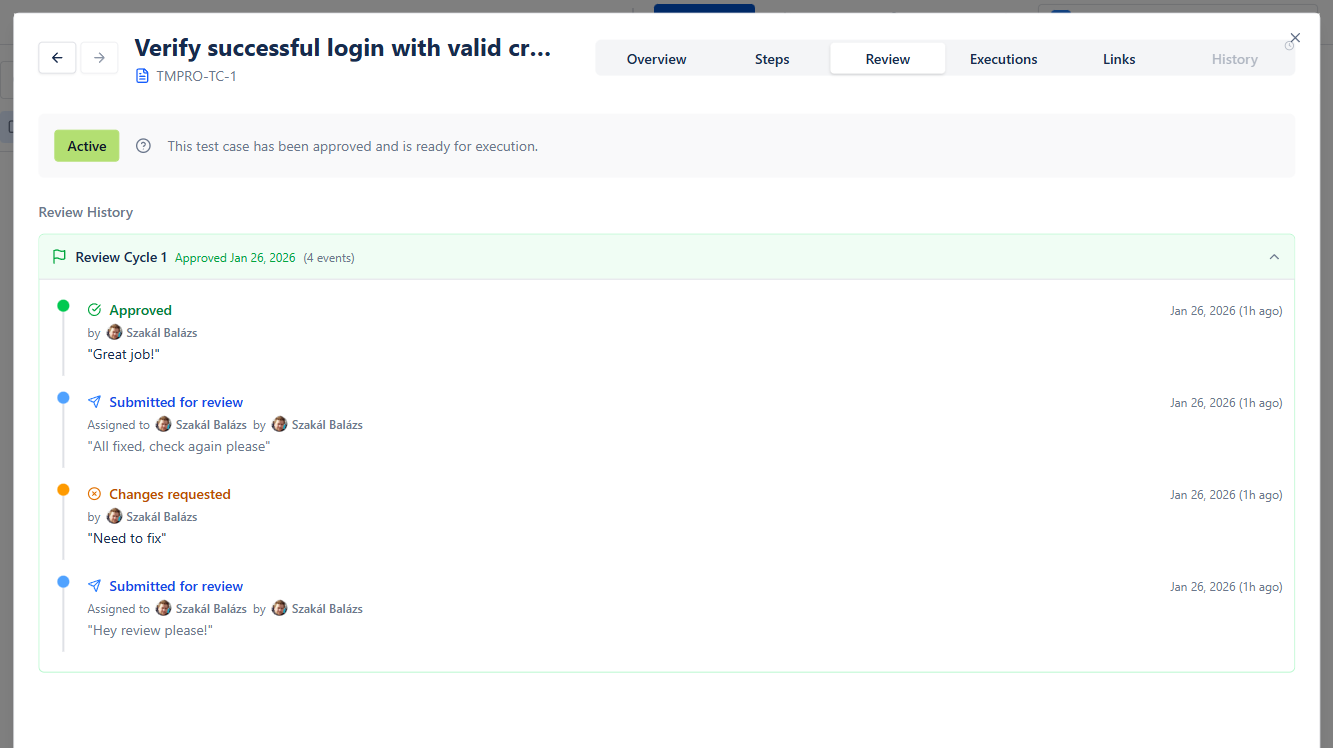
BesTest Implementation:
BesTest has this workflow built-in. Test cases can be submitted for review, reviewers see a queue of pending reviews, and only approved test cases can be added to test cycles.
Test Case Review Checklist
Use this checklist when reviewing test cases:
Structure
- •[ ] Title clearly describes what's being tested
- •[ ] Unique, meaningful test case ID
- •[ ] Appropriate priority assigned
- •[ ] Correct category/module assignment
Preconditions
- •[ ] All preconditions listed
- •[ ] Preconditions are achievable
- •[ ] No assumptions left unstated
Steps
- •[ ] Steps are numbered sequentially
- •[ ] Each step has a single action
- •[ ] Steps are unambiguous (one interpretation)
- •[ ] Technical terms are accurate
- •[ ] Data values are specific
Expected Results
- •[ ] Expected result for each step or group
- •[ ] Results are objectively verifiable
- •[ ] Results are specific (not "works correctly")
Coverage
- •[ ] Traces to at least one requirement
- •[ ] Covers the intended scenario
- •[ ] Doesn't duplicate existing test cases
- •[ ] Includes verification of key outcomes
Independence
- •[ ] Can be executed standalone
- •[ ] Doesn't depend on another test's execution
- •[ ] Cleans up after itself (if needed)
Instead of: "Steps are unclear"
Write: "Step 3 says 'enter valid data' - please specify the exact values to enter (e.g., email: test@example.com, password: Test123!)"
Review Best Practices
For Authors:
- •Self-review before submitting
- •Include context in review request
- •Respond to feedback constructively
- •Update promptly, don't let reviews go stale
For Reviewers:
- •Review within agreed SLA (e.g., 24-48 hours)
- •Be specific in feedback
- •Explain the "why" behind suggestions
- •Approve when ready, don't block on minor issues
- •Use a checklist for consistency
For Teams:
- •Define review criteria and share checklist
- •Rotate reviewers to share knowledge
- •Track review metrics (time, revision rate)
- •Retrospect on review process
- •Celebrate quality improvements
- Rubber stamping: Approving without real review
- Gatekeeping: Excessive scrutiny blocking progress
- Staleness: Reviews sitting in queue for days
- Inconsistency: Different reviewers, different standards
Measuring Review Effectiveness
Track these metrics to improve your review process:
Process Metrics:
- •Review cycle time: Time from submission to approval
- •First-pass approval rate: % approved without changes
- •Revision rate: Average revisions per test case
- •Review queue size: Pending reviews at any time
Quality Metrics:
- •Defects found in execution: Issues in approved test cases
- •Test case clarity issues: Misinterpretations during execution
- •Coverage gap discoveries: Missing scenarios found later
Targets:
- •Review cycle time: < 48 hours
- •First-pass approval rate: > 70%
- •Post-approval defect rate: < 5%
Improvement Actions:
- •High revision rate → Better author training, clearer guidelines
- •Long cycle time → More reviewers, priority rules
- •Post-approval defects → Stricter checklist, reviewer training
Frequently Asked Questions
Should every test case be reviewed?
Ideally yes, but prioritize based on risk. Critical test cases must be reviewed. For lower-priority tests, consider lighter review or spot checks. The goal is quality assurance without creating bottlenecks.
Who should review test cases?
Peer testers are ideal reviewers—they understand testing and can execute the test cases. Developers can review for technical accuracy. Product owners can review for requirement coverage. Rotate reviewers to spread knowledge.
How long should a review take?
A thorough review of one test case typically takes 5-15 minutes depending on complexity. Batch reviews (5-10 test cases) are more efficient than reviewing one at a time. Set expectations with your team based on your cadence.
What tools support test case review workflows?
BesTest has built-in review workflow with states, transitions, and reviewer assignment. Other tools may require custom Jira workflows or manual processes. The key is having a defined process regardless of tooling.
Built-in Test Case Review with BesTest
BesTest includes a complete review workflow—submit for review, track pending reviews, approve or request changes. Quality gates built into your testing process.
Try BesTest Free