


Why Your Choice of Test Management Tool Matters
Jira is the backbone of agile development for millions of teams, but it was never designed to handle structured test management. There are no native test cases, no execution tracking, no coverage reports. That gap has spawned a thriving ecosystem of test management tools on the Atlassian Marketplace - and picking the wrong one can cost your team months of migration pain.
This guide is a practitioner-level comparison of six leading Jira test management tools in 2026. We built BesTest, so we are transparent about our perspective, but we have done our best to present every tool fairly. Each has genuine strengths, and the right choice depends on your team's size, workflow, and priorities.
The tools covered:
 BesTest
 Zephyr Scale
 Xray
Xray AIO Tests
 RTM
RTM TestRail
Let's dig in.
How We Evaluated Each Tool
To keep this comparison useful and fair, we assessed every tool against the same criteria:
Architecture
Where does test data live? This is arguably the most consequential decision you will make. Tools either store data as Jira issues (giving you JQL access but contributing to issue bloat) or in a separate database (keeping Jira clean but requiring the tool's own search).
Platform
Is the tool built on Atlassian Forge, Atlassian Connect, or as a standalone product? Forge apps run inside Atlassian's infrastructure with enterprise-grade sandboxing. Connect apps run on the vendor's own servers and communicate with Jira via API. Standalone tools live entirely outside Jira.
Core Features
Test case management, test execution, requirements traceability, reporting, and automation support.
User Experience
Does the tool feel native to Jira, or does it require learning a separate interface?
Pricing Approach
Free tiers, per-user pricing, and how costs scale as your team grows.
Best Fit
What kind of team benefits most from this particular tool?
We are the makers of BesTest. We present it first because we know it best, not because it wins every category. We encourage you to trial any tool before committing.
BesTest
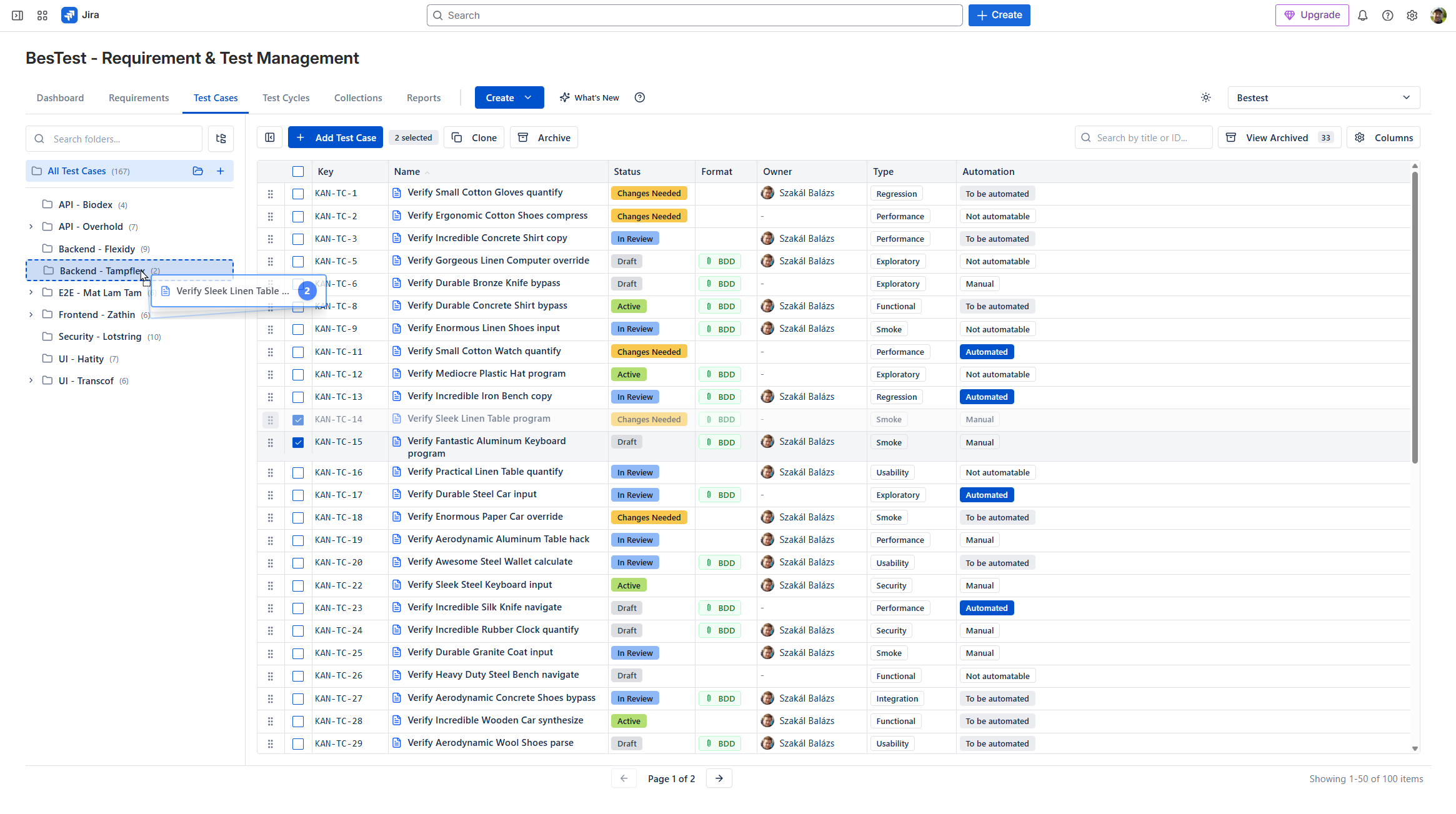
What it is: A Jira-native test and requirements management app built on Atlassian Forge. BesTest stores test data separately from Jira issues, so your Jira instance stays clean regardless of how many test cases you create.
Architecture: Forge-native with enterprise-grade security. Test data is stored in a dedicated database outside the Jira issue system, eliminating issue bloat while keeping everything accessible inside the Jira UI.
Key Features:
- •Requirements management with a significance-based coverage model (significance = dev complexity x impact)
- •Test case management with folder hierarchy
- •Test execution with a dedicated test player
- •BQL - a JQL-like query language purpose-built for test data
- •Smart Collections - rule-based, auto-updating test groups
- •Test case review workflow
- •Dashboard gadgets for Jira
- •Release prediction
- •Traceability matrix
- •Dark theme
- •1-click project enablement (~1 minute setup)
Pros:
- •Zero issue bloat - test data lives outside Jira
- •Enterprise-grade security via Forge (sandboxing, identity management, permissions)
- •Built-in requirements management with coverage tracking
- •Smart Collections save hours of manual test cycle setup
- •Free for up to 10 users with full functionality
- •Fast onboarding - appears in global Apps menu and project menu bar
- •Modern UI that follows Atlassian Design System
Cons:
- •Younger product - smaller install base compared to Zephyr or Xray
- •No CI/CD automation integration yet (on the roadmap)
- •No REST API for external integrations yet
- •Fewer third-party tutorials and community resources
Pricing: Free for up to 10 users. Paid tiers scale by user count.
Best for: Jira Cloud teams of any size that want structured test management without Jira issue bloat, and teams that need built-in requirements traceability. Particularly strong for teams starting fresh who want fast setup and a clean architecture.
Zephyr Scale
What it is: One of the most established test management tools for Jira, now owned by SmartBear. Zephyr Scale (formerly TM4J - Test Management for Jira) is widely used by enterprise teams and has a large install base on the Atlassian Marketplace.
Architecture: Connect app with separate storage. Test data is stored on SmartBear's infrastructure, not as Jira issues. This avoids issue bloat but means data is processed outside Atlassian's environment.
Key Features:
- •Test case management with folders, labels, and components
- •Test cycles and test plans for organizing execution
- •Parameterized test cases and test data sets
- •Traceability to Jira issues (stories, bugs, epics)
- •REST API for CI/CD integration
- •Advanced reporting and custom dashboards
- •Data import/export (Excel, CSV, other tools)
- •Cross-project test case reuse
Pros:
- •Mature, battle-tested at enterprise scale
- •Strong automation and CI/CD integration via REST API
- •Separate storage avoids issue bloat
- •Extensive reporting and export capabilities
- •Large community and documentation resources
- •Well-supported migration paths from other tools
Cons:
- •Connect architecture - data processed outside Atlassian infrastructure
- •Can feel complex for smaller teams
- •Pricing can be steep at higher tiers
- •UI has its own conventions separate from Jira's native look
- •No built-in requirements management - relies on linking to Jira issues
Pricing: Free tier available (limited). Paid plans based on user count; enterprise pricing can be significant.
Best for: Mid-to-large enterprise teams that need mature automation integrations, advanced reporting, and have the budget to support it. A safe choice for organizations that prioritize proven track record over cutting-edge architecture.
See the full BesTest vs Zephyr Scale comparison | Looking for a Zephyr Scale alternative?
Xray
What it is: A comprehensive test management tool by Idera that stores test entities as native Jira issues. Xray is popular among teams that want their test data fully searchable via JQL and deeply embedded in Jira workflows.
Architecture: Connect app with Jira issue storage. Every test case, test execution, test plan, and test set is a Jira issue. This gives you full JQL power over test data but adds thousands of issues to your Jira instance.
Key Features:
- •Test cases, preconditions, test sets, test plans, and test executions - all as Jira issue types
- •Full JQL support for querying test data
- •BDD/Cucumber integration with Gherkin syntax
- •CI/CD integration (Jenkins, Bamboo, GitLab, etc.)
- •REST API for automation
- •Requirements coverage reports
- •Parameterized and data-driven testing
- •Supports manual, automated, and BDD testing in one tool
Pros:
- •Full JQL access to all test data - powerful for teams that live in JQL
- •Excellent automation and BDD/Cucumber support
- •Deep Jira integration - test entities behave like regular issues
- •Strong CI/CD pipeline integration
- •Comprehensive documentation and active community
- •Supports manual, automated, and exploratory testing workflows
Cons:
- •Issue bloat - every test artifact is a Jira issue, which can significantly impact performance at scale
- •Backlog pollution - test issues appear in sprint views, boards, and searches
- •Steeper learning curve due to multiple custom issue types
- •Connect architecture - data processed externally
- •Can be expensive at scale
- •Complex setup for full automation pipelines
Pricing: Free for small teams. Paid plans based on Jira user count.
Best for: Teams with strong automation needs, existing BDD/Cucumber workflows, or a deep dependency on JQL for reporting. If your team already thinks in Jira issues and you are comfortable managing issue bloat, Xray is powerful.
See the full BesTest vs Xray comparison | Looking for an Xray alternative?
AIO Tests
What it is: A lightweight test management app by Navarambh that positions itself as a simple, affordable option for Jira teams. AIO Tests focuses on ease of use and offers a competitive free tier.
Architecture: Connect app with separate storage. Test data is stored outside Jira issues, avoiding bloat.
Key Features:
- •Test case management with folders and labels
- •Test cycles for organizing execution
- •Bulk operations for test case management
- •Traceability to Jira issues
- •Import from CSV, Excel, and other tools
- •Basic reporting and dashboards
- •Automation via REST API
- •BDD support
Pros:
- •Affordable - one of the most budget-friendly options
- •Clean, straightforward UI with low learning curve
- •Separate storage avoids issue bloat
- •Decent free tier
- •Good import capabilities for migration
- •Responsive support team
Cons:
- •Connect architecture - data hosted externally
- •Reporting is more basic compared to Zephyr Scale or Xray
- •Fewer advanced features (no Smart Collections, no release prediction)
- •Smaller ecosystem and community
- •No built-in requirements management
- •Automation integration is less mature
Pricing: Competitive free tier. Paid plans are among the most affordable in the category.
Best for: Budget-conscious teams that need solid fundamentals without enterprise complexity. A good entry point for teams moving away from spreadsheets that want something simple and affordable.
See the full BesTest vs AIO Tests comparison | Looking for an AIO Tests alternative?
Try BesTest Free for Up to 10 Users
Forge-native test management with built-in requirements, Smart Collections, and zero Jira issue bloat. Set up in under a minute.
Install from MarketplaceRequirements and Test Management for Jira (RTM)
What it is: A test management app by Deviniti that, like Xray, stores test entities as Jira issues. RTM differentiates itself by including built-in requirements management alongside test management.
Architecture: Connect app with Jira issue storage. Test cases, test plans, and requirements are all stored as Jira issue types. This gives you full JQL support but contributes to issue bloat.
Key Features:
- •Requirements management as Jira issues
- •Test case management as Jira issues
- •Traceability matrix between requirements and tests
- •Test execution and reporting
- •Coverage analysis
- •Full JQL support for all test entities
- •Workflow customization through Jira's native workflows
- •Import/export capabilities
Pros:
- •Built-in requirements management (one of few tools offering this)
- •Full JQL access to test and requirement data
- •Uses Jira's native workflows - no separate workflow engine to learn
- •Good traceability between requirements, tests, and defects
- •Familiar Jira-native experience for issue management
Cons:
- •Issue bloat - every test and requirement is a Jira issue
- •Connect architecture
- •Smaller user base and community compared to Zephyr or Xray
- •Reporting is less sophisticated
- •Performance can degrade with large test suites due to issue volume
- •UI can feel dated in some areas
Pricing: Free tier available. Paid plans based on user count.
Best for: Teams that want requirements and test management in one tool and are comfortable with the Jira issue storage model. Good for organizations where JQL access to requirements is a hard requirement.
See the full BesTest vs RTM comparison | Looking for an RTM alternative?
TestRail
What it is: A standalone test management platform by Gurock (now part of IDERA). TestRail is not a Jira plugin - it is a separate application that offers a Jira integration. It has been around since 2004 and has one of the largest user bases in the test management space.
Architecture: Standalone application with Jira integration via plugin. Test data lives entirely in TestRail's own infrastructure (cloud or on-premises). The Jira integration syncs data bidirectionally but is not embedded in Jira's UI.
Key Features:
- •Full-featured test case management with sections and suites
- •Test runs and test plans
- •Milestone tracking
- •Comprehensive reporting with charts and metrics
- •REST API for automation
- •CI/CD integration
- •Custom fields and templates
- •On-premises and cloud deployment options
- •Multi-project support
Pros:
- •Extremely mature and feature-rich - one of the oldest tools in the category
- •Excellent reporting and analytics
- •On-premises option for teams with strict data residency requirements
- •Strong REST API and automation ecosystem
- •Large community, extensive documentation, and third-party integrations
- •Independent of Jira - works even if you switch project management tools
Cons:
- •Not embedded in Jira - requires switching between two applications
- •Jira integration is an add-on, not a native experience
- •Separate user management and permissions
- •Additional cost on top of Jira licensing
- •Can feel disconnected from your Jira workflow
- •UI is functional but showing its age
Pricing: Per-user pricing with cloud and server options. No free tier - trial only. Can be expensive when combined with Jira licensing costs.
Best for: Teams that need a dedicated, standalone test management platform and treat Jira integration as a nice-to-have rather than a requirement. Strong for organizations that might switch away from Jira in the future, or that need on-premises deployment.
See the full BesTest vs TestRail comparison | Looking for a TestRail alternative?
Side-by-Side Comparison
Here is a high-level comparison to help you see the differences at a glance:
| Criteria | BesTest | Zephyr Scale | Xray | AIO Tests | RTM | TestRail |
|---|---|---|---|---|---|---|
| Platform | Forge | Connect | Connect | Connect | Connect | Standalone |
| Data Storage | Separate (dedicated DB) | Separate (SmartBear) | Jira Issues | Separate | Jira Issues | Standalone DB |
| Issue Bloat | None | None | Yes | None | Yes | N/A |
| Built-in Requirements | Yes | No | No | No | Yes | No |
| Smart Collections | Yes | No | No | No | No | No |
| Test Player | Yes | Yes | Yes | Yes | Yes | Yes |
| CI/CD Integration | Roadmap | Yes | Yes | Yes | Limited | Yes |
| BDD Support | No | Limited | Yes | Yes | No | No |
| REST API | Roadmap | Yes | Yes | Yes | Limited | Yes |
| Query Language | BQL | No | JQL (via issues) | No | JQL (via issues) | No |
| Free Tier | 10 users | Trial only | Trial only | 10 users | Trial only | No (trial) |
| On-Premises | No | No | Data Center | No | Data Center | Yes |
| Jira-Native UI | Yes (Forge) | Partial | Yes (issues) | Partial | Yes (issues) | No |
| Maturity | Newer | Established | Established | Mid | Mid | Veteran |
Key Takeaways from the Table:
- •If Forge security matters: BesTest is the only Forge-native option, with enterprise-grade security provided by Forge's sandboxing, identity management, and permission model.
- •If you need CI/CD now: Zephyr Scale, Xray, and TestRail have the most mature automation stories.
- •If you need JQL for test data: Xray and RTM store everything as Jira issues (with the trade-off of bloat). BesTest is also launching BQL - a JQL-like query language purpose-built for test data - giving you powerful search without the issue bloat trade-off.
- •If budget is tight: BesTest and AIO Tests are free for up to 10 users with full functionality. Beyond that, BesTest remains competitively priced as your team grows.
- •If you might leave Jira: TestRail is the safest bet as a standalone platform.
- •If you need built-in requirements: BesTest and RTM are the primary options.
How to Choose the Right Tool for Your Team
There is no universally "best" tool - only the best tool for your context. Here is a decision framework:
Start with Architecture
This is the most impactful decision. Ask yourself:
- •Do you need test data searchable via JQL? If yes, consider Xray or RTM (but accept issue bloat). BesTest also offers BQL, a JQL-like query language built specifically for test data, so you get powerful search without issue bloat.
- •Do you want Jira to stay clean? Choose a separate-storage tool: BesTest, Zephyr Scale, or AIO Tests.
- •Do you need a standalone platform? Choose TestRail.
Then Consider Scale
| Team Size | Recommendation |
|---|---|
| 1-10 users | BesTest (free tier), AIO Tests, or Zephyr Scale free tier |
| 10-50 users | BesTest, Zephyr Scale, or Xray depending on automation needs |
| 50-200 users | Zephyr Scale or Xray for enterprise features; BesTest if requirements management is key |
| 200+ users | Zephyr Scale, Xray, TestRail, or BesTest - all handle enterprise scale. Zephyr Scale and Xray have ISO certifications; BesTest scales well technically but is newer to the enterprise segment |
Factor in Workflow Needs
- •Heavy automation/CI/CD: Xray or Zephyr Scale
- •BDD/Cucumber workflows: Xray
- •Requirements traceability: BesTest or RTM
- •Quick setup, low overhead: BesTest or AIO Tests
- •On-premises/data residency: TestRail or Xray/RTM (Data Center)
Run a Real Trial
Do not choose based on feature lists alone. Install the top two candidates and run them through a real sprint:
- •Create 20-30 test cases reflecting your actual work
- •Execute a mini test cycle
- •Generate a report for your stakeholders
- •Assess how the tool felt day-to-day
The tool that fits your workflow matters more than the tool with the longest feature list.
Migration Considerations
If you are switching from an existing tool:
- •Check import capabilities (CSV, Excel, API-based migration). BesTest supports importing both test cases and requirements out of the box.
- •Plan for a parallel-run period
- •Prioritize migrating active test cases first - do not migrate obsolete tests
- •Budget 2-4 weeks for a full migration depending on volume
Conclusion
The Jira test management landscape in 2026 offers genuine variety. Each tool we covered has a defensible position:
- •BesTest brings Forge-native security, zero issue bloat, and built-in requirements management - ideal for teams that want a clean, modern architecture with fast setup.
- •Zephyr Scale is the proven enterprise choice with mature automation integrations and a large community.
- •Xray is the most powerful option for teams invested in BDD, CI/CD, and JQL-driven workflows - if you can manage the issue bloat.
- •AIO Tests delivers solid fundamentals at the best price point, making it a smart entry-level choice.
- •RTM uniquely combines requirements and test management in the Jira issue model.
- •TestRail remains the gold standard for standalone test management, independent of any project management tool.
The right tool depends on your architecture preferences, automation needs, team size, and budget. Trial before you commit, and prioritize the tool that fits how your team actually works - not just the one with the most features on paper.
Frequently Asked Questions
What is the difference between Forge and Connect apps for Jira?
Forge apps run on Atlassian's platform and benefit from enterprise-grade security features like sandboxing, identity management, and built-in permissions. Connect apps run on the vendor's own servers and communicate with Jira via API. Forge is generally considered more secure and is Atlassian's recommended platform for new apps. Currently, BesTest is the only Forge-native test management tool in this comparison.
What is Jira issue bloat and which tools cause it?
Issue bloat occurs when a test management tool stores test cases, executions, and results as Jira issues. With thousands of test cases and regular execution cycles, this can add tens of thousands of issues to your Jira instance, slowing searches, cluttering backlogs, and degrading performance. Xray and RTM use this approach. BesTest, Zephyr Scale, and AIO Tests store data separately to avoid bloat. TestRail is standalone and does not affect Jira's issue count at all.
Can I migrate test cases between these tools?
Yes, most tools support import from CSV and Excel files, which provides a common interchange format. Some tools also offer direct migration utilities or REST APIs that can be scripted for bulk transfers. When migrating, focus on active test cases first, verify data integrity with a small batch, and plan for a 2-4 week parallel run period.
Which tool is best for teams that also need requirements management?
BesTest and RTM both include built-in requirements management. BesTest uses a significance-based coverage model where significance equals dev complexity multiplied by impact, and stores requirements separately from Jira issues. RTM stores requirements as Jira issues, giving you JQL access but contributing to bloat. Other tools rely on linking to existing Jira stories for requirements traceability.
Is there a free Jira test management tool?
BesTest and AIO Tests are free for up to 10 users with full functionality - these are the most generous free tiers in the category. Other Atlassian Marketplace tools like Zephyr Scale, Xray, and RTM offer a free evaluation period (typically 30 days), but do not have permanent free tiers for small teams. TestRail also only offers a trial. For teams on a budget, BesTest and AIO Tests are the strongest options.
Do I need CI/CD integration in my test management tool?
It depends on your testing maturity. If your team runs automated tests in CI/CD pipelines and wants results reported back into the test management tool, then yes - CI/CD integration is important, and Xray, Zephyr Scale, and TestRail are the strongest options today. If your team primarily does manual testing or is just starting with test management, CI/CD integration is a nice-to-have that you can adopt later.
Try BesTest Free for Up to 10 Users
Forge-native test management with built-in requirements, Smart Collections, and zero Jira issue bloat. Set up in under a minute.
Install from Marketplace