API Testing Management in Jira
Organize, execute, and track API test cases alongside your functional tests
API testing validates backend services and integrations, forming the backbone of modern application quality. Suppose your team maintains a payment processing platform with 40+ microservices communicating via REST APIs. A developer updates the order service to support a new discount type, and suddenly the inventory service starts returning unexpected error codes. Without centralized API test management, these integration-level defects slip through because each team tests their own service in isolation. BesTest lets you manage API test cases, track coverage across services, and coordinate manual and automated testing efforts in Jira so that cross-service regressions get caught before they reach production.
The Challenge
API testing has specific management needs that differ from UI-level testing. The tests are inherently more technical, dealing with HTTP methods, request payloads, authentication tokens, and response schemas. But the organizational challenges are just as significant as the technical ones: keeping API test documentation current as endpoints evolve, coordinating between teams that own different services, and making sure test results from automated tools are visible alongside manual test efforts. Teams commonly face these difficulties:
- •Documenting endpoints, methods, headers, request bodies, and expected responses in a structured way that testers can follow consistently, rather than relying on informal Slack messages or outdated wiki pages.
- •Managing test data and authentication across different environments (development, staging, production), where tokens expire, test databases get reset, and environment-specific configurations change without notice.
- •Linking API tests to integration requirements so that coverage gaps are visible at the architectural level, not just within individual services.
- •Coordinating manual and automated API tests, especially when some endpoints are covered by automated suites running in CI/CD while others require manual execution with specific data setups.
- •Reporting API test coverage to backend teams who think in terms of services and endpoints, not test cases and test cycles.
- •Handling API versioning, where v1 and v2 of the same endpoint may need different test cases, and deprecated versions still need maintenance testing until they are fully retired.
- •Testing error handling and edge cases systematically, because APIs that work perfectly on the happy path but fail ungracefully on malformed input are a common source of production incidents.
- •Keeping API test documentation synchronized with the actual API specifications, especially in fast-moving teams where the API changes faster than the documentation can keep up.
How BesTest Helps
BesTest handles API test management effectively with structured documentation and the organizational tools needed to keep pace with rapidly evolving backend systems. Rather than scattering API test knowledge across automation scripts, Postman collections, and wiki pages, BesTest centralizes everything in Jira where it is linked to requirements, stories, and defects. This gives API teams the same level of test management rigor that UI testing teams have always had, without forcing them into a workflow that does not fit their needs.
Structured API Test Cases
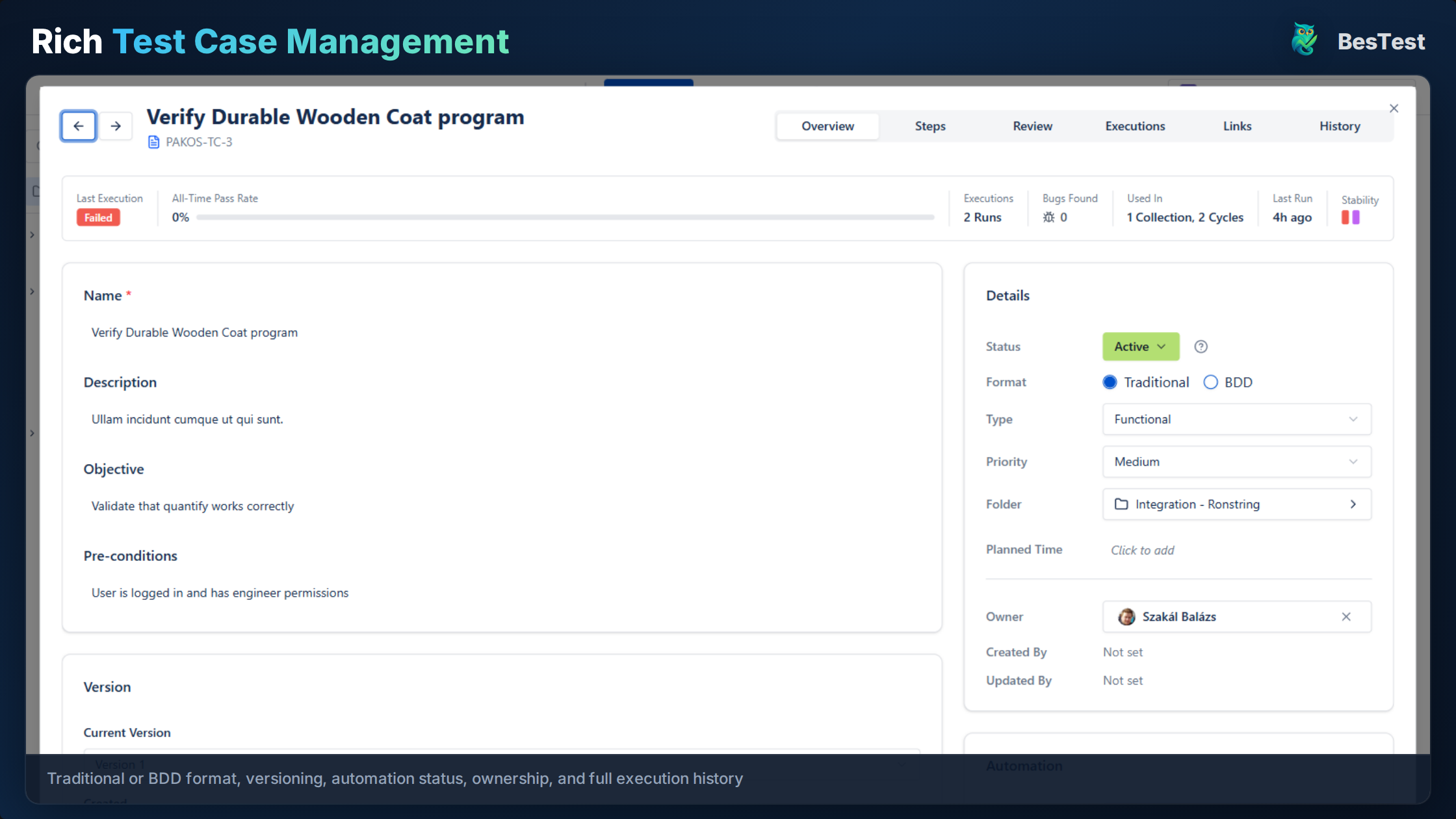
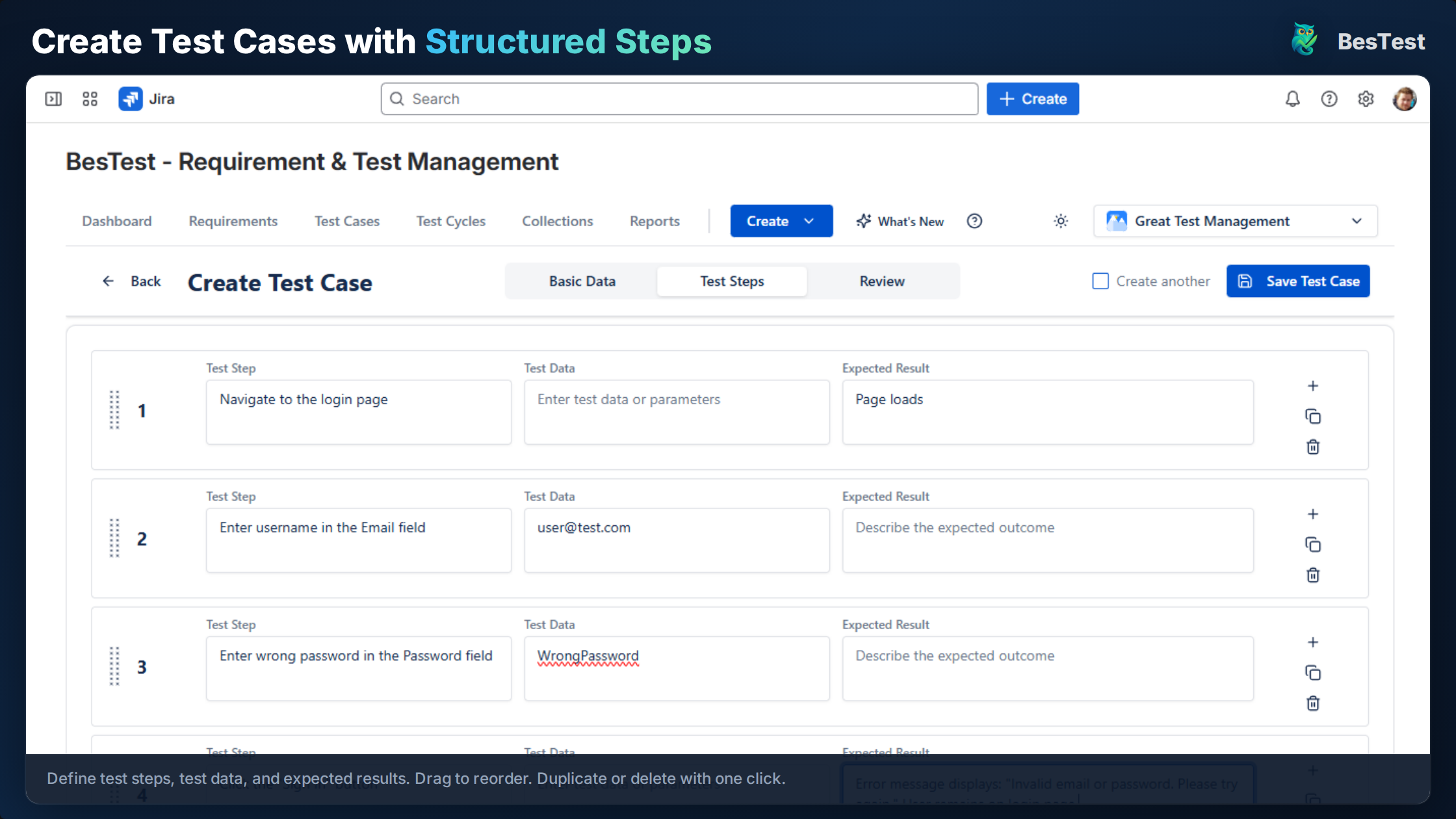
Document the endpoint, HTTP method, headers, request body, and expected response in clearly defined test steps. BesTest's step format is flexible enough to accommodate the structured nature of API testing while keeping the information scannable. Testers can include sample request payloads and expected JSON responses directly in the test steps, creating a self-contained reference for each endpoint.
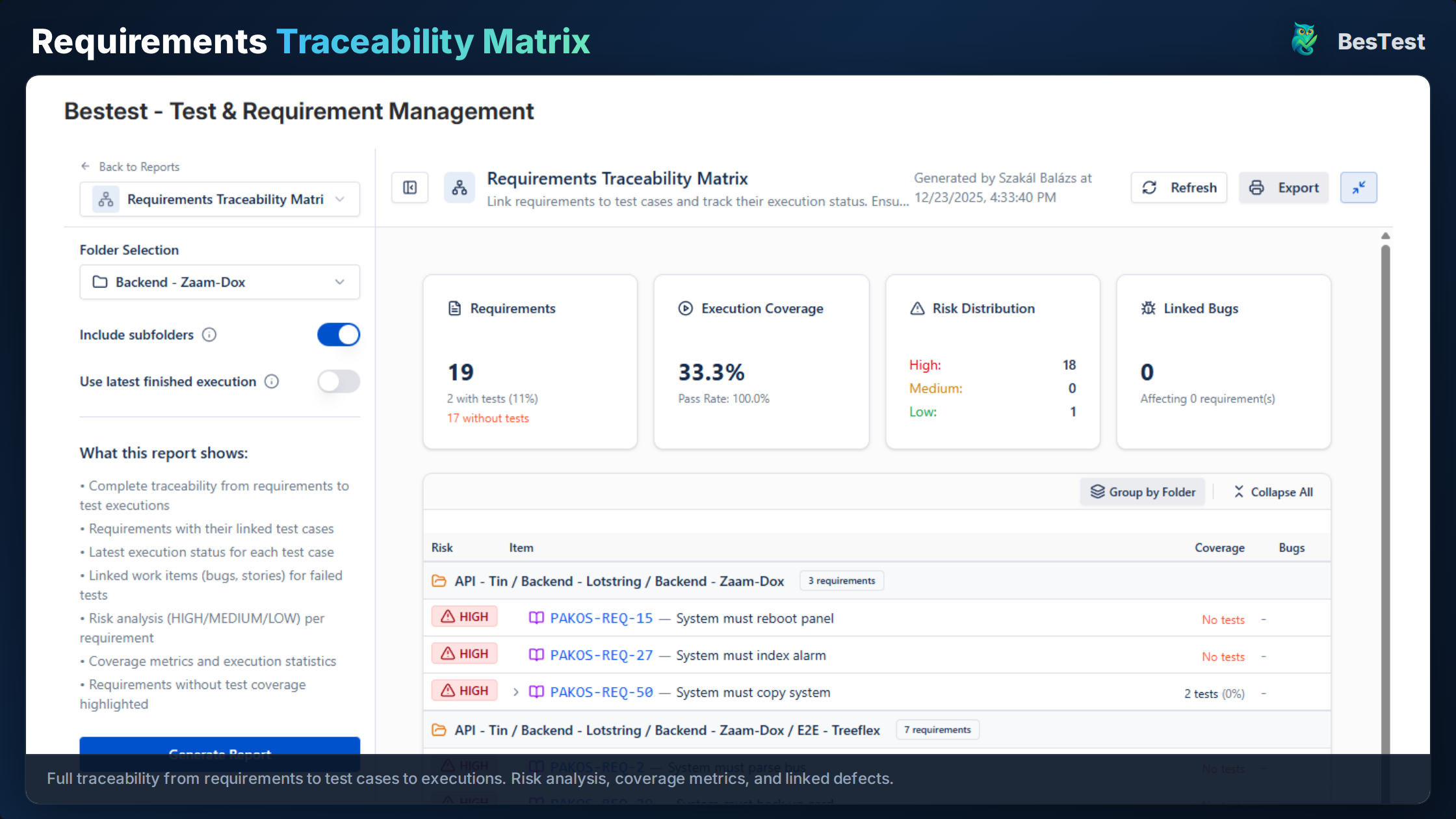
Requirements Traceability
Link API tests to integration requirements and track coverage of backend functionality across your entire service landscape. The traceability matrix highlights which services have comprehensive test coverage and which have gaps, making it straightforward to prioritize testing effort where the risk is highest. This is especially valuable during architecture reviews where stakeholders need to understand the quality posture of the entire system.
Automation Integration
Tag automated API tests and import results via CI/CD integration. BesTest distinguishes between manually executed tests and automated ones, so you can see at a glance which endpoints are covered by automation and which still require manual verification. When an automated test fails in CI, the result is reflected in the same dashboard that tracks manual testing, giving the team a unified view of API quality.
Organized by Service
Use folders to organize tests by microservice, API version, or business domain. As your service architecture grows, the folder structure scales with it. Each team can own their section of the test repository while sharing a common organizational framework that makes cross-team test discovery straightforward.
Test Data Management
Document test data requirements in preconditions for consistent execution. Each API test case can specify the exact data setup needed, including database state, authentication credentials, and dependent service configurations. This documentation ensures that any tester can execute the test without needing to reverse-engineer the data requirements from the test steps themselves.
Contract Testing Support
Create test cases that validate API contracts between services. Document the expected request and response schemas, and track which consumer-provider relationships have been verified. When a service updates its API contract, the linked test cases make it immediately clear which consumers need to be retested.
Environment Configuration
Tag test cases with environment-specific information so testers know which base URLs, authentication tokens, and test data sets to use in each environment. This reduces the "it works in staging but not in production" problem by making environment differences explicit and trackable.
Key Benefits
How to Implement
Document API Contracts
Create requirements for each API endpoint, defining the expected inputs, outputs, error codes, and edge cases. Work with the development team to ensure these requirements reflect the actual API specification, not just assumptions based on documentation. Include details like rate limits, pagination behavior, and authentication requirements that testers need to know.
Create API Test Cases
For each endpoint, create test cases covering the happy path, validation errors, authentication failures, authorization boundaries, and edge cases. Structure each test case with the endpoint URL, HTTP method, headers, request body, expected status code, and expected response body as distinct steps. This level of detail makes the tests executable by any team member, not just the person who wrote them.
Organize by Service
Create folders for each microservice or API domain, with subfolders for different API versions if applicable. Keep tests organized as APIs grow by establishing naming conventions early, such as prefixing test case titles with the endpoint path. A well-structured repository is the difference between a team that can find and update tests in seconds and one that spends minutes searching every time.
Execute and Document
Run API tests manually using tools like Postman or cURL, or via automated suites in CI/CD. Document actual responses and any variations from the expected behavior in the test execution results. When automation is in place, import results into BesTest so that automated and manual test outcomes are visible in the same dashboard, giving stakeholders a complete picture of API quality.
Track Coverage
Use the requirements coverage matrix to ensure all API endpoints have test coverage across their documented scenarios. Identify endpoints that are only covered by happy path tests and prioritize adding error handling and edge case coverage. Revisit coverage after each sprint to account for new endpoints, deprecated versions, and changes to existing contracts.
Best Practices
- •Include the endpoint URL, HTTP method, and expected status code in test titles for quick scanning. A title like "POST /api/orders - 201 Created" is far more useful than "Test order creation."
- •Document request bodies, headers, and authentication requirements in preconditions so testers can set up the request correctly without consulting external documentation.
- •Test both success and error responses for every endpoint. An API that returns the right data on valid input but crashes on malformed input is a security and reliability risk.
- •Keep API tests independent so they do not rely on execution order. Each test should set up its own preconditions and clean up after itself, enabling parallel execution and random ordering.
- •Version test cases when API versions change, keeping the old version's tests intact until that version is officially deprecated and decommissioned.
- •Include response time expectations in performance-sensitive API tests so the team can catch latency regressions during functional testing, not just during dedicated performance test cycles.
- •Create shared test data fixtures that are documented and maintained centrally, rather than having each tester create their own ad-hoc test data that may conflict with other testers.
- •Review API test coverage whenever a production incident involves an API failure. If the failure scenario was not covered by existing tests, add a test case immediately as part of the incident response.
Ready to Improve Your API Testing Management?
BesTest provides all the tools you need—requirements traceability, smart collections, review workflows, and a Jira-native experience. Free for up to 10 users.
Try BesTest FreeRelated Use Cases
Security Testing Management in Jira
Organize and track security test cases and vulnerability verification
Regression Testing in Jira
Automate your regression test cycles with smart collections and traceability
Sprint Testing in Jira
Integrate testing into your agile sprints with test cycles tied to sprint stories