Test Case Review Workflow
Implement quality gates for test cases with built-in review and approval
Test case review ensures quality before execution, catching ambiguities, gaps, and errors when they are cheapest to fix. Imagine a tester on your team writes 15 new test cases for a payment processing feature, submits them, and they go directly into the next test cycle without anyone else looking at them. During execution, three tests fail not because of defects in the product, but because the test steps are ambiguous and different testers interpret them differently. Another two tests pass despite a real defect because the expected results are too vague to detect the issue. A structured review process would have caught all five problems before execution even began. BesTest provides a built-in review workflow that creates this quality gate, ensuring every test case is clear, complete, and correct before it consumes execution time.
The Challenge
Without a formal review process, test case quality varies widely across the team and degrades over time. Experienced testers may write thorough, unambiguous test cases, while newer team members produce tests that are vague or miss critical scenarios. The problem compounds because poor test cases are not just wasteful to execute; they actively undermine confidence in the test results. When a test passes but nobody is sure whether the expected result was actually verified, the pass is meaningless. Teams consistently encounter these quality problems:
- •Unclear or ambiguous test steps that different testers interpret differently, leading to inconsistent results and debates about whether a test actually passed or failed.
- •Missing preconditions and expected results that force testers to make assumptions during execution, introducing variability and reducing the reliability of the test outcome.
- •Duplicate or overlapping tests that waste execution time without adding coverage, bloating the test suite and increasing maintenance burden for no quality benefit.
- •Tests that do not match the current requirements because they were written against an earlier version of the specification and never updated when the requirements changed.
- •Inconsistent quality across team members, with some testers producing detailed, precise test cases and others writing vague outlines that are barely more useful than a checklist item.
- •Missing negative test cases and edge cases because the test author focused on the happy path and did not consider what happens when inputs are invalid, permissions are insufficient, or dependent services are unavailable.
- •Poorly structured test steps that combine multiple verifications into a single step, making it impossible to determine which specific check failed when the step is marked as failed.
- •Test cases that are technically correct but impractical to execute because they require test data setups, environment configurations, or timing conditions that are not documented in the preconditions.
How BesTest Helps
BesTest has a built-in test case review workflow with quality gates that require no configuration. The review process is embedded into the natural lifecycle of a test case: authors create, reviewers evaluate, and only approved test cases can be included in test cycles. This is not an administrative burden layered on top of the testing process; it is a quality investment that pays for itself by eliminating the rework, confusion, and false results that poor test cases generate during execution.
Review Workflow
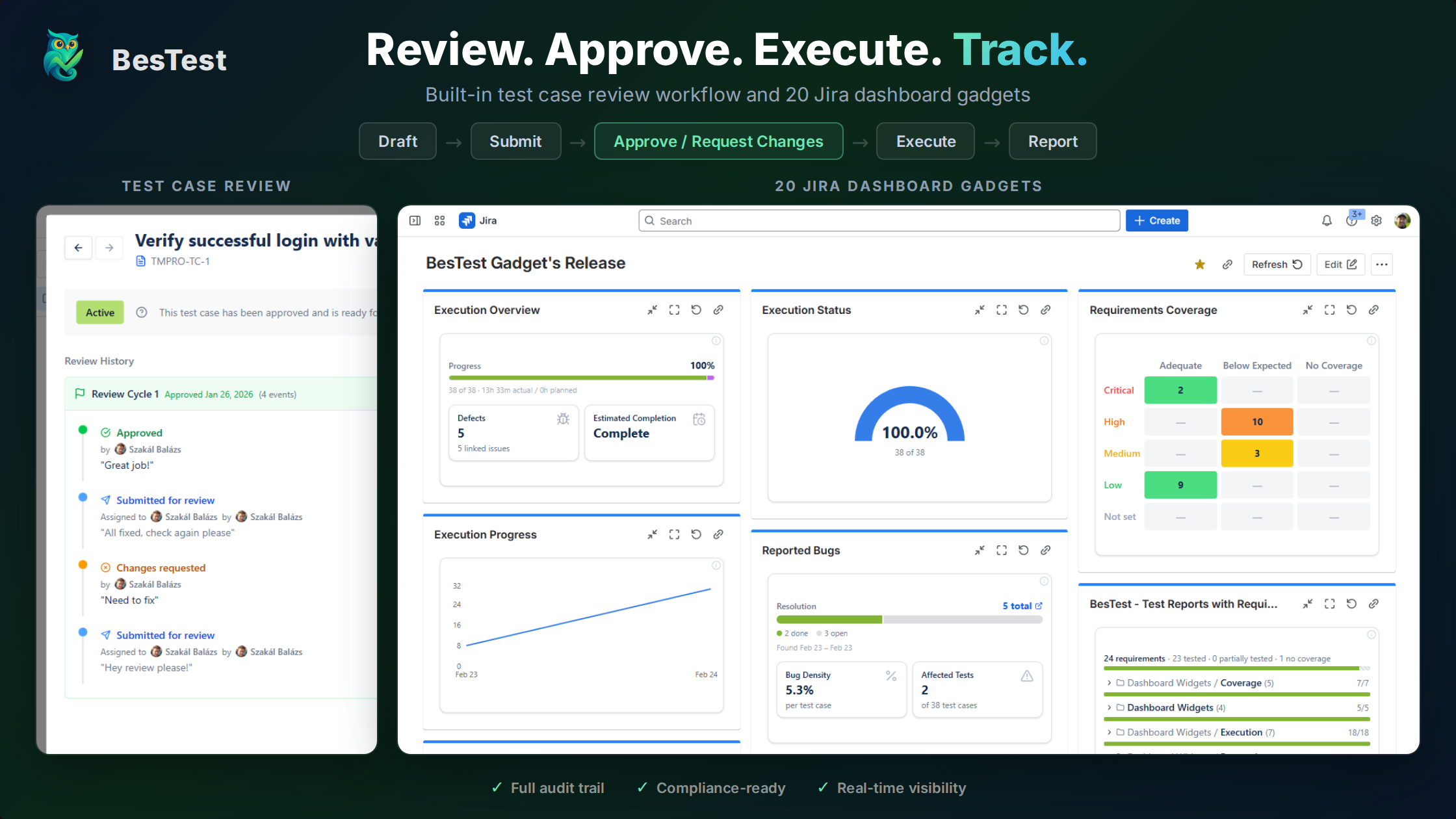
Test cases progress through Draft, In Review, and Approved states with clear ownership at each stage. The workflow is visible on every test case, so the entire team knows the status at a glance. Authors cannot accidentally skip the review step because the state machine enforces the progression, and only approved test cases are eligible for inclusion in test cycles.
Reviewer Assignment
Assign specific reviewers based on their expertise, or let team members pick from a review queue based on their availability. The assignment flexibility means that complex security test cases can be routed to the security specialist while straightforward functional tests can be reviewed by any senior tester. This targeted approach ensures that the reviewer has the domain knowledge to evaluate the test case thoroughly.
Quality Checklist
Apply consistent review criteria across all test cases by establishing a team-wide checklist that reviewers follow. Common criteria include: are the preconditions complete, are the steps unambiguous, are the expected results specific and verifiable, does the test trace to a requirement, and is the test data documented. This consistency prevents the quality bar from fluctuating based on which reviewer happens to pick up the test case.
Feedback Loop
Reviewers can request changes with specific, line-level feedback that guides the author toward the needed improvements. Rather than a binary approve/reject, the feedback mechanism supports a conversation between author and reviewer that improves both the test case and the author's skills over time. The feedback history is preserved, creating a learning resource for the entire team.
Execution Gate
Only approved test cases can be added to test cycles, creating a hard quality gate that prevents untested assumptions from entering the execution pipeline. This gate eliminates the common scenario where a hastily written test case is included in a cycle "just this once" and then remains in the suite forever because nobody goes back to review it after the deadline passes.
Bulk Review
When a batch of related test cases needs review, such as all tests for a new feature, the reviewer can work through them in sequence without navigating back to the queue between each one. This streamlined workflow makes review sessions efficient and encourages reviewers to process their queue regularly rather than letting it accumulate.
Review Metrics
Track review throughput, average time to review, revision rate, and reviewer workload distribution. These metrics help the team identify bottlenecks in the review process and ensure that the quality gate does not become a workflow bottleneck that delays test execution.

Key Benefits
How to Implement
Write Test Case
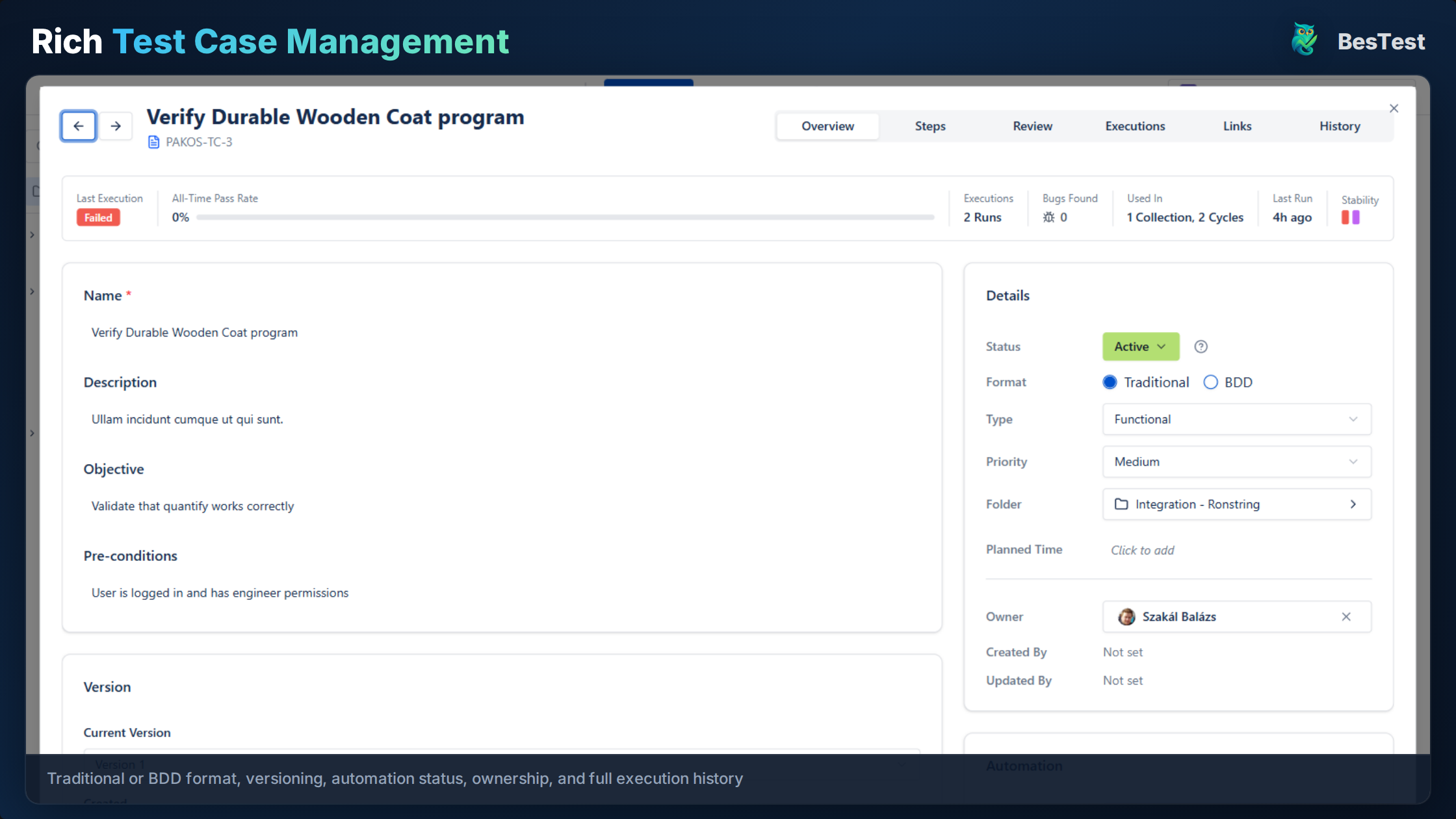
The author creates a test case in Draft status, completing all fields including preconditions, step-by-step instructions, expected results, and test data requirements. Before submitting for review, the author should self-review against the team's quality checklist to catch obvious issues. This self-review step reduces the reviewer's workload and accelerates the review cycle by eliminating easily avoidable revision rounds.
Submit for Review
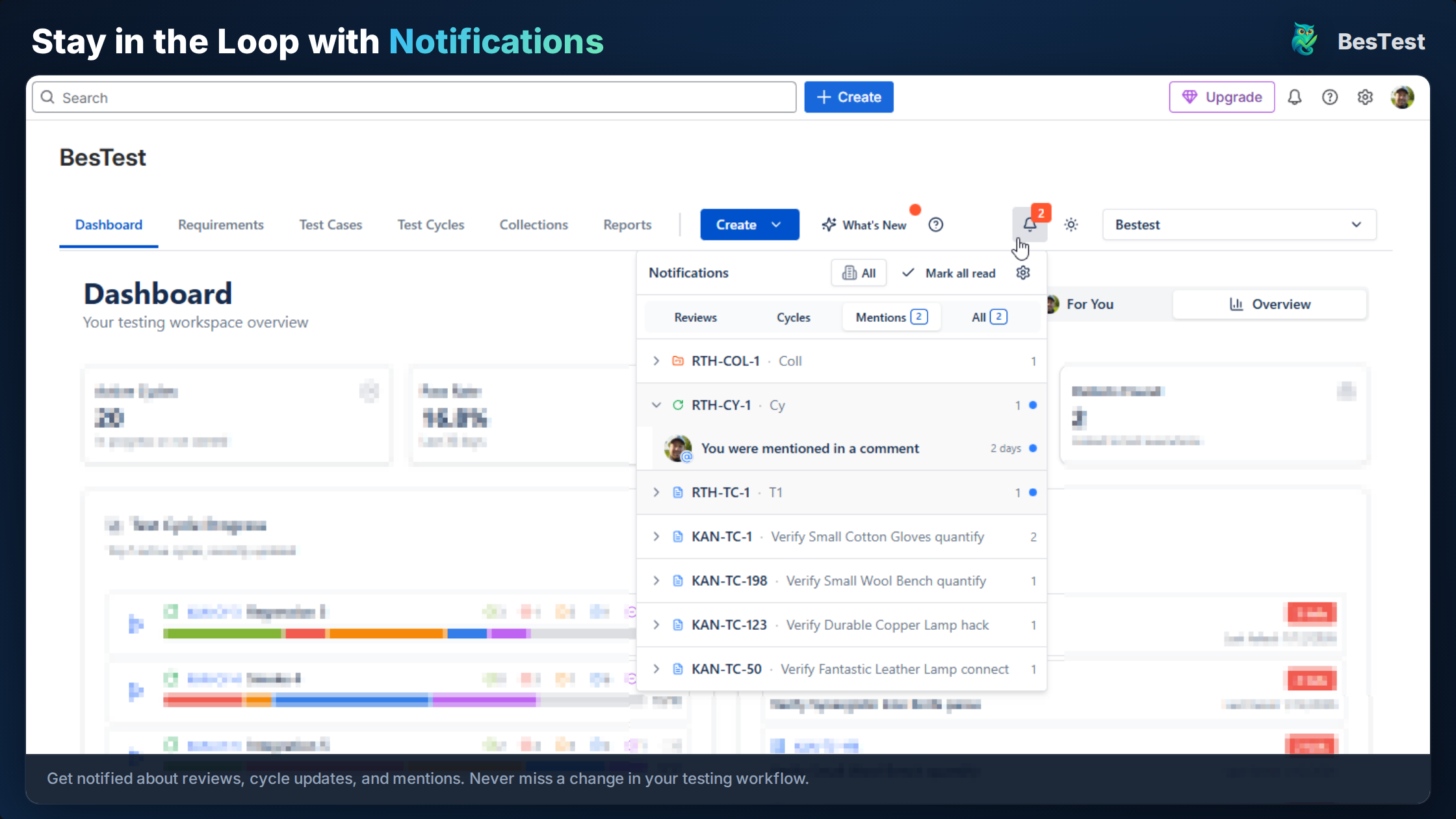
The author submits the test case for review, optionally assigning a specific reviewer who has domain expertise relevant to the test case. If no specific reviewer is assigned, the test case enters the general review queue where any qualified team member can pick it up. The submission triggers a notification so reviewers are aware of pending work.
Review and Feedback
The reviewer evaluates the test case against the team's quality criteria: Are the steps clear and unambiguous? Are the expected results specific enough to verify? Are preconditions complete? Does the test trace to a requirement? The reviewer either approves the test case or requests changes with specific, constructive feedback that helps the author understand exactly what needs to be improved and why.
Revise if Needed
The author addresses the reviewer's feedback and resubmits the test case. This revision cycle continues until the test case meets the quality bar. Most test cases are approved within one or two revision rounds. If a test case requires more than two rounds, it may indicate that the author needs additional training or that the feature's requirements are not clear enough to write testable scenarios.
Add to Test Cycle
Approved test cases are eligible for inclusion in test cycles. The execution gate ensures that only reviewed and approved tests consume execution time, giving the team confidence that every test in the cycle will produce a meaningful, reliable result. When building a test cycle, the approved status acts as a filter that naturally excludes work-in-progress tests.
Best Practices
- •Define and share review criteria with the team in a visible document or wiki page so that both authors and reviewers have the same expectations about what constitutes a quality test case.
- •Complete reviews within 24-48 hours to avoid creating a bottleneck that delays test execution. If reviews consistently take longer, consider adding more reviewers or reducing the batch size.
- •Provide specific, actionable feedback rather than vague comments like "needs improvement." Tell the author exactly which step is unclear and suggest how to make it more precise.
- •Rotate reviewers to spread knowledge across the team and prevent a single person from becoming the review bottleneck. Rotation also exposes each team member to different testing approaches and feature areas.
- •Track review metrics to identify process improvements, such as which types of test cases require the most revisions and whether certain authors consistently need more feedback.
- •Use the review process as a mentoring opportunity for junior testers. Pair them with senior reviewers who can provide educational feedback that builds testing skills, not just corrects individual test cases.
- •Review test cases in batches for related features rather than individually. Reviewing a set of tests together helps the reviewer spot coverage gaps, overlapping tests, and inconsistencies that are not visible when looking at each test in isolation.
- •Establish a "review day" or dedicated time block so the team builds a habit around reviews rather than treating them as interruptions to their primary work.
- •Periodically audit previously approved test cases to verify that they still meet the quality bar. Requirements change, features evolve, and a test case that was excellent six months ago may now be outdated or incomplete.
Ready to Improve Your Test Case Review Workflow?
BesTest provides all the tools you need—requirements traceability, smart collections, review workflows, and a Jira-native experience. Free for up to 10 users.
Try BesTest FreeRelated Use Cases
Sprint Testing in Jira
Integrate testing into your agile sprints with test cycles tied to sprint stories
User Acceptance Testing (UAT) in Jira
Validate that the software meets business requirements with stakeholder-driven testing
Smoke Testing in Jira
Quick sanity checks to verify critical functionality after deployments
Related Guides & Definitions
Test Case Review: Best Practices for Quality Assurance
Learn why test case review is essential for quality assurance and how to implement an effective review workflow. Includes checklists, templates, and tool recommendations.
How to Write Test Cases: The Complete 2026 Guide
Learn the art and science of writing test cases that catch bugs, are easy to maintain, and provide clear documentation. This guide covers everything from basic structure to advanced techniques used by professional QA teams.
Test Case
A documented set of conditions and steps used to verify that a software feature works as expected.
Quality Assurance (QA)
A systematic process of ensuring that products and services meet defined quality standards.