
The requirements coverage report for Jira: which requirements are not safe to ship, and why.
Jira has no requirement coverage report. BesTest adds one inside Jira: every requirement gets a test state, and a risk from its Impact and Complexity. The report says the reason in plain words. See how old your test evidence is, and how many test cases you still need to write.
- Reads
- Requirements from a folder, a BQL rule, or Jira work items with all their children. Results from every cycle, or the cycles you pick. Or a saved data set.
- Answers
- 8 ready questions, 4 cards, a panel per requirement with the reasons.
- Takes out
- Print (PDF). CSV, one row per requirement.
 12345
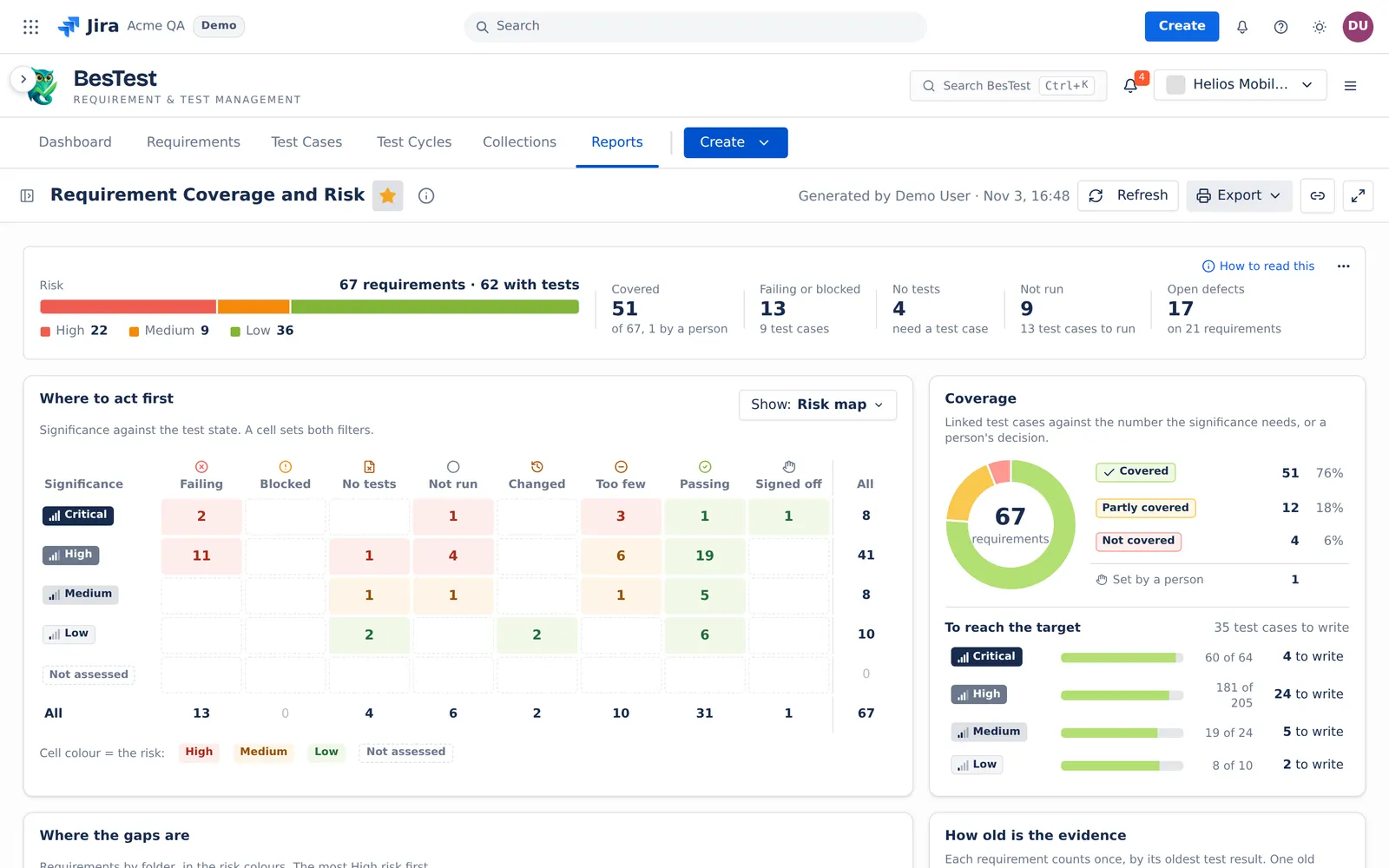
- 1One line for the whole scope67 requirements, 62 with tests. 22 High, 9 Medium, 36 Low risk. Click a number for its requirements.
- 2How to read thisThe figures of the top line, each with your number and its rule, and the risk table.
- 3Where to act firstSignificance against the test state. A cell opens its requirements, with both filters set.
- 4To reach the targetThe test cases still to write per significance: 35 here.
- 5SourcesA folder, a BQL rule or Jira work items. Or a saved data set, as here.
Ask the table. It filters itself.
Click a question. The table keeps the requirements that match its rule. The rows are real rows of the Helios space (15 of 67).
| Requirement | Risk | Significance | Test state | Coverage | Oldest result |
|---|---|---|---|---|---|
| BANK-REQ-1 Customers sign in with a password or biometrics | High | Critical | Failing | Covered8 of 8 | 1 d |
| BANK-REQ-11 Customers send domestic payments | High | Critical | Failing | Covered8 of 8 | 21 d |
| BANK-REQ-63 Export the spending report | High | Critical | Not run | Covered8 of 8 | 12 d |
| BANK-REQ-4 Customers manage their trusted devices | High | Critical | Too few tests | Partly6 of 8 | 1 d |
| BANK-REQ-8 Mark pending transactions | High | High | Failing | Covered6 of 5 | 8 d |
| BANK-REQ-5 Warn on compromised devices | High | High | No tests | Not0 of 5 | None |
| BANK-REQ-12 Schedule payments and standing orders | High | High | Not run | Partly1 of 5 | 11 d |
| BANK-REQ-9 Customers manage their accounts | Medium | High | Too few tests | Partly4 of 5 | 1 d |
| BANK-REQ-34 Customers export their transactions | Medium | Medium | No tests | Not0 of 3 | None |
| BANK-REQ-14 Customers send international payments | Medium | Medium | Not run | Covered5 of 3 | 32 d |
| BANK-REQ-18 Replace a lost or stolen card | Low | Critical | Signed off | Coveredby a person | None |
| BANK-REQ-19 Add the card to a mobile wallet | Low | Critical | Passing | Covered8 of 8 | 14 d |
| BANK-REQ-6 Show real-time balances | Low | High | Passing | Covered6 of 5 | 7 d |
| BANK-REQ-21 Customers see their direct debits | Low | Low | Changed after test | Covered2 of 1 | 13 d |
| BANK-REQ-28 Respect notice periods | Low | Low | Changed after test | Covered3 of 1 | 26 d |
- BANK-REQ-1 Customers sign in with a password or biometricsHighCriticalFailingCovered8 of 8Oldest: 1 d
- BANK-REQ-11 Customers send domestic paymentsHighCriticalFailingCovered8 of 8Oldest: 21 d
- BANK-REQ-63 Export the spending reportHighCriticalNot runCovered8 of 8Oldest: 12 d
- BANK-REQ-4 Customers manage their trusted devicesHighCriticalToo few testsPartly6 of 8Oldest: 1 d
- BANK-REQ-8 Mark pending transactionsHighHighFailingCovered6 of 5Oldest: 8 d
- BANK-REQ-5 Warn on compromised devicesHighHighNo testsNot0 of 5Oldest: None
- BANK-REQ-12 Schedule payments and standing ordersHighHighNot runPartly1 of 5Oldest: 11 d
- BANK-REQ-9 Customers manage their accountsMediumHighToo few testsPartly4 of 5Oldest: 1 d
- BANK-REQ-34 Customers export their transactionsMediumMediumNo testsNot0 of 3Oldest: None
- BANK-REQ-14 Customers send international paymentsMediumMediumNot runCovered5 of 3Oldest: 32 d
- BANK-REQ-18 Replace a lost or stolen cardLowCriticalSigned offCoveredby a personOldest: None
- BANK-REQ-19 Add the card to a mobile walletLowCriticalPassingCovered8 of 8Oldest: 14 d
- BANK-REQ-6 Show real-time balancesLowHighPassingCovered6 of 5Oldest: 7 d
- BANK-REQ-21 Customers see their direct debitsLowLowChanged after testCovered2 of 1Oldest: 13 d
- BANK-REQ-28 Respect notice periodsLowLowChanged after testCovered3 of 1Oldest: 26 d
Significance × test state.No black box.
The test state is the worst fact of the requirement, in this order. The risk comes from one table you can read. A person's Covered closes a coverage gap. It never hides a failed, blocked or not run test.
- Failinga linked test case failed in its newest finished result
- Blockeda linked test case is blocked, and none failed
- No testsno linked test case, and nobody marked it covered
- Not runa test case has no finished result, or its newest is Skipped
- Changed after testthe requirement text changed after a result
- Too few testsevery test passed, but the coverage is not Covered: too few test cases, or a person set Not covered
- Passingevery test passed, and the requirement is covered
- Signed offno test case, and a person set it to Covered
| Significance | Failing | Blocked | No tests | Not run | Changed | Too few | Passing | Signed off |
|---|---|---|---|---|---|---|---|---|
| Critical | High | High | High | High | High | High | Low | Low |
| High | High | High | High | High | High | Medium | Low | Low |
| Medium | High | Medium | Medium | Medium | Medium | Medium | Low | Low |
| Low | Medium | Medium | Low | Low | Low | Low | Low | Low |
| Not assessed | No risk, whatever the test state | |||||||
Example from the Helios space: BANK-REQ-12 "Schedule payments and standing orders"
- Its Impact and Complexity give High significance, so it needs 5 test cases. It has 1.
- The newest result of that test case is Skipped: the state is Not run. High × Not run = High risk. Coverage: 1 of 5, Partly covered.
- If the test case passes: every test passed, but 1 is fewer than 5. Too few tests, Medium risk.
- If a person then sets Covered: Passing, Low risk. If the test case fails later: Failing, High risk, also with the person's Covered.
From the whole picture to one requirement.With the reason in words.
 12345
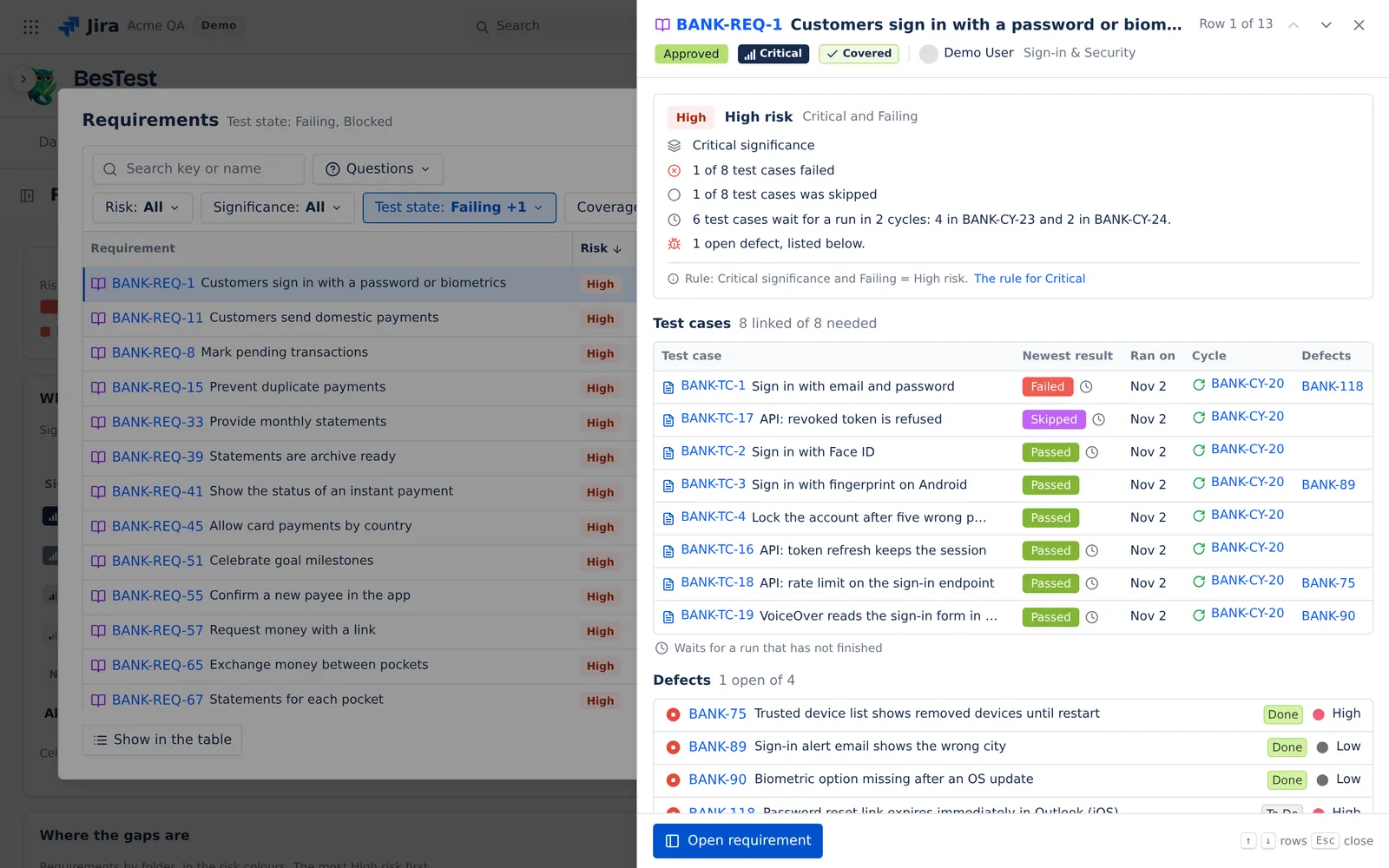
- 1The risk, in a few wordsHigh risk: Critical and Failing.
- 2Each fact behind it1 of 8 test cases failed, 1 was skipped, 6 wait for a run in 2 cycles, 1 open defect.
- 3The ruleCritical significance and Failing = High risk. A link shows the rule for Critical.
- 4The test casesEach with its newest result, run day, cycle and defects. A clock marks a run that waits.
- 5Walk the rowsRow 1 of 13. Up and Down open the next requirement.
Where to act, what is covered, where the gaps are, how old the evidence is
Where to act first
A risk map: significance against test state. A cell opens its requirements, with both filters set.
Coverage
Covered, Partly covered, Not covered and Set by a person. "To reach the target": the test cases still to write per significance.
Where the gaps are
Requirements by folder in the risk colours, the most High risk first.
How old is the evidence
Each requirement by its oldest result: 0 to 7, 8 to 30, 31 to 90, over 90 days, or Never ran.
Questions people ask
How do I report requirement test coverage in Jira?
Open Requirement Coverage and Risk and pick the requirements: a folder, a BQL rule or Jira work items. Each requirement shows Covered, Partly covered or Not covered, from its linked test cases against the number its significance needs.
What is risk-based testing, and how do I report on it?
Risk-based testing tests the most important and most fragile parts first. Here each requirement with an Impact and a Complexity gets a risk from its significance and its test state. "Requirements to act on first" lists the High risk ones, the most significant first.
Does a person's Covered hide a failing test?
No. A person's Covered closes a coverage gap. It never hides a failed, blocked or not run test.
What does "Changed after test" mean?
No test failed, is blocked or waits for a run, and the requirement text changed after one of the newest results. The text is the name, the description and the custom fields. A change of status, owner, folder, Impact or Complexity is not a text change.
How old is the test evidence for my requirements?
"How old is the evidence" puts each requirement in one band by its oldest result: 0 to 7, 8 to 30, 31 to 90 or over 90 days, or Never ran. One old result makes the evidence old.
Open Requirement Coverage and Risk in your Jira.
Install BesTest from the Atlassian Marketplace. It is free for teams of up to 10 users. Or try the report first in the live demo, on the Helios demo data.
Read how the report works