
Test Execution Time: planned vs actual, and when testing will finish
Will we finish on time? Compare the planned time with the time your testers really spend, and get an estimated finish date at their real pace. When the data is too thin for a date, the report says so, and says why.
- Reads
- The runs of the cycles you pick, or a saved data set. The planned time of each test case, and the run time the Test Player timer saves.
- Answers
- An estimated finish date, the planned, done and spent hours, Where the hours went, and a test case table with ready chips.
- Takes out
- Print (PDF). Excel: every table. CSV: every test case, one file. An Excel button on each block.
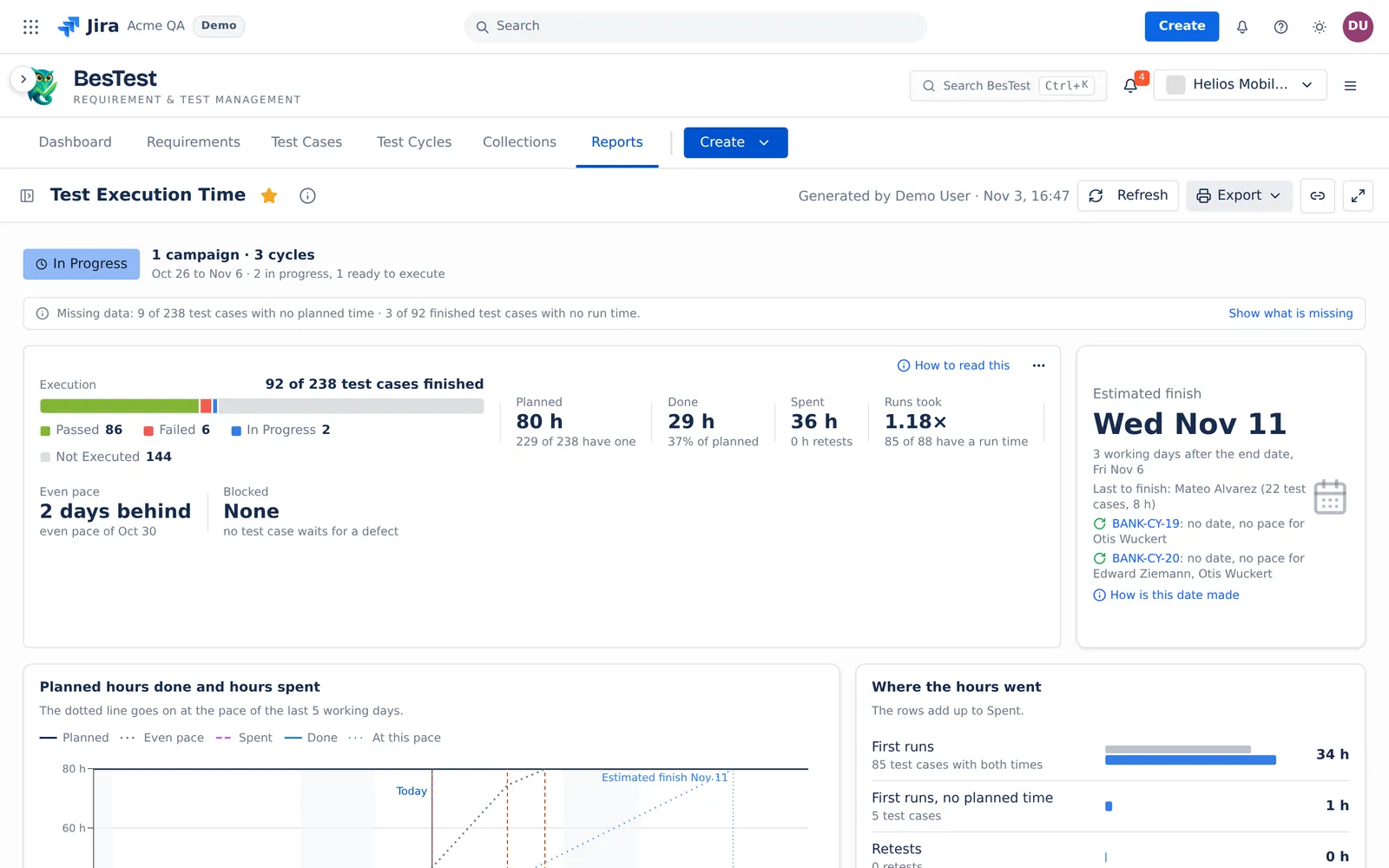 12345
- 1Estimated finishA date at the real pace of your testers, the last to finish, and the cycles with no date and why.
- 2Even pace2 days behind the plan.
- 3Planned, done, spent80 h planned, 29 h of it done, 36 h spent.
- 4Missing data, said out loud9 of 238 test cases have no planned time. "Show what is missing", then "Show them" filters the table.
- 5The chartThe dotted line goes on at the pace of the last 5 working days.
A date you can check.With the names behind it.
Test Execution Time has no Questions menu. Its key screen is the date card: the estimated finish, the last tester to finish, and each cycle that gets no date, with the reason.
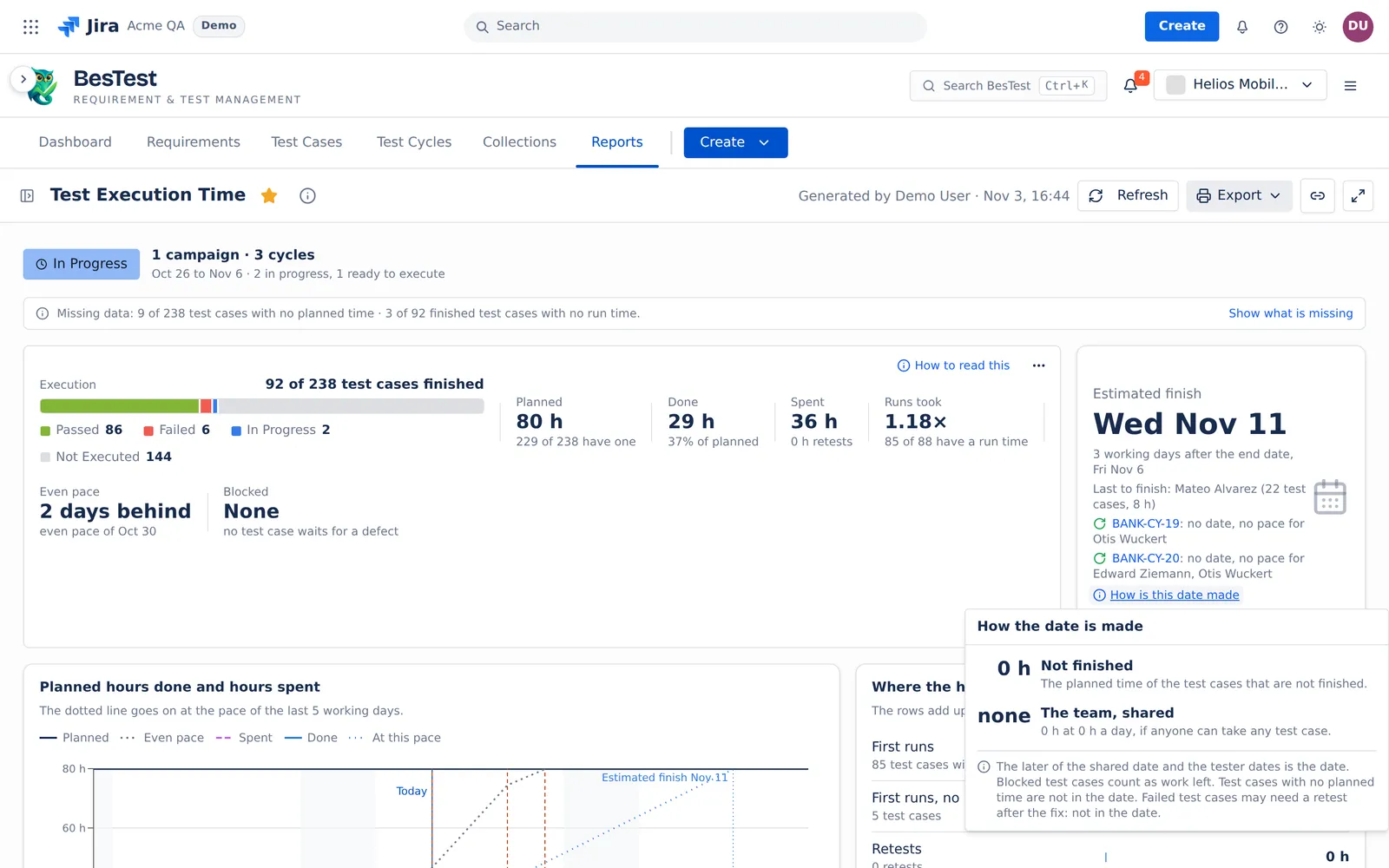 12345
- 1Estimated finishWed Nov 11: 3 working days after the end date.
- 2Last to finishThe tester whose own pace gives the latest date.
- 3No date, and whyA cycle with a tester who has no pace gets no date. The report names it.
- 4How is this date madeOpens the calculation of the date.
- 5The ruleThe later of the shared date and the tester dates is the date. Blocked test cases count as work left.
The real pace of your testers.Or no date, and the reason.
- 1
Pace. The planned time of the test cases finished in the last 5 working days, divided by those working days. Days before the start date do not count.
- 2
Days needed. The planned time of the work left, divided by the pace, rounded up.
- 3
Each tester. Each tester with work left gets a date at their own pace in the same 5 days. The latest date is the estimated finish, and it names the last to finish.
- 4
No date. A cycle gets no date when fewer than 50% of its test cases have a planned time, when a tester with work left has no pace, or when nothing finished in the 5 days. The report names each cycle with no date, and the reason.
Three stages, each with its own view
Not started
Every cycle is Draft or Ready to Execute. Work per tester, Fix the plan before you start, and the size by folder.
Running
The estimated finish, the chart of planned hours done and hours spent, and Where the hours went.
Finished
Every cycle is Done. How many working days it took against the plan, Where the hours went from the plan at the start to Spent, and what blocked testing.
Ready chips
The test case table filters itself in one click.
- Over the plan
- As planned
- Under the plan
- No planned time
- No run time
- Not finished
Questions people ask
How do I track the actual time spent on test execution in Jira?
Run the test cases in the BesTest Test Player. Its timer saves the run time of each run. Spent adds the run time of every run with a result: first runs, retests and blocked tries. A result set without the timer has no run time, and the report says how many.
How is the finish date of a test cycle forecast?
The pace is the planned time of the test cases finished in the last 5 working days, divided by those days. The work left, divided by the pace, gives the days needed. Each tester with work left also gets a date at their own pace, and the latest date wins.
What happens when a cycle has no start or end date?
With no start date, a running cycle starts on the day it went In Progress, and a cycle not started yet starts today. With no end date, the report still gives a date, but no even pace and no late or early. It tells you to set an end date.
Where did the testing hours go in a finished cycle?
"Where the hours went" goes from Planned at the start, through Added, Not finished, Runs took longer, No run time, Skipped, No planned time, Retests and Blocked tries, to Spent. The rows add up to Spent.
Open Test Execution Time in your Jira.
Install BesTest from the Atlassian Marketplace. It is free for teams of up to 10 users. Or try the report first in the live demo, on the Helios demo data.
Read how the report works